
A teenager in a small town watches a physics lecture from a professor thousands of miles away. A working mother learns graphic design after putting her kids to sleep. A retired engineer joins an online language class simply because he finally has the time. Education today does not wait for a bell to ring or a classroom door to open. It moves with people, quietly fitting itself into everyday life.
That shift is exactly why digital education has become one of the most important changes in modern learning. It is not just about replacing textbooks with screens. It is about changing who gets access to knowledge, how learning happens, and what education even means in a connected world.
For many people, digital education began as a temporary adjustment during difficult global circumstances. But somewhere along the way, it evolved into something much bigger. Students, professionals, teachers, and even employers realized that learning could be more flexible, more personal, and sometimes surprisingly more effective than traditional systems allowed.
Learning Has Become More Personal Than Ever
One of the most noticeable things about digital education is how differently people can now approach learning. In a traditional classroom, everyone usually moves at the same pace. Some students struggle to keep up while others feel bored waiting for the lesson to move forward. Online learning platforms changed that dynamic completely. People can pause lectures, replay explanations, skip ahead, or spend extra time on difficult concepts without feeling embarrassed.
That level of control matters more than it first appears. A friend of mine once admitted that he understood mathematics better through online tutorials than he ever did in school. The reason was simple. He could revisit the same explanation five times without worrying about slowing down an entire class. That freedom removed pressure from the learning process.
Digital education also allows people to learn according to their real interests rather than only fixed academic structures. Someone interested in photography can start learning immediately. Another person can explore coding, finance, animation, or even philosophy without needing formal enrollment in a university. In many ways, curiosity itself has become easier to act on.
Technology Is Impressive, but Access Still Matters
There is no denying that technology has made education more accessible in extraordinary ways. A smartphone and internet connection can now open doors that once required expensive institutions or physical relocation. But digital education also exposes a difficult reality. Access is still uneven.
In urban areas, students may attend virtual classes with high-speed internet and modern devices. In rural or economically struggling communities, even stable connectivity can be a challenge. Some families share one phone between multiple children attending online classes. Others struggle with expensive data plans or unreliable electricity.
This gap often gets overlooked when people talk about the future of education. Technology alone does not automatically create equal opportunity. Infrastructure, affordability, and digital literacy matter just as much. Without those things, digital education risks helping some groups move ahead faster while leaving others behind. That is why conversations around online learning need to go beyond apps and platforms. The human side of accessibility matters just as much as innovation itself.
Teachers Are Adapting in Ways People Rarely Notice
A lot of attention goes toward students in digital education, but teachers have experienced enormous change too. Teaching online requires far more than simply speaking into a webcam. Educators now juggle video platforms, digital assignments, discussion boards, online assessments, and shorter attention spans all at once. Many had to learn these systems quickly while continuing to support students emotionally and academically.
And honestly, good online teaching is harder than it looks. In physical classrooms, teachers can immediately sense confusion through facial expressions or body language. Online, those signals are weaker or completely absent. Keeping students engaged through a screen requires creativity, patience, and constant adaptation.
Some educators have handled this transition remarkably well. Others are still figuring it out. That is perfectly understandable because digital education is evolving faster than most institutions expected.
Business Digital Learning Is Expanding Rapidly
The rapid growth of online learning is also transforming the education industry itself. Platforms offering courses, certifications, tutoring, and professional development have expanded dramatically over the last few years.
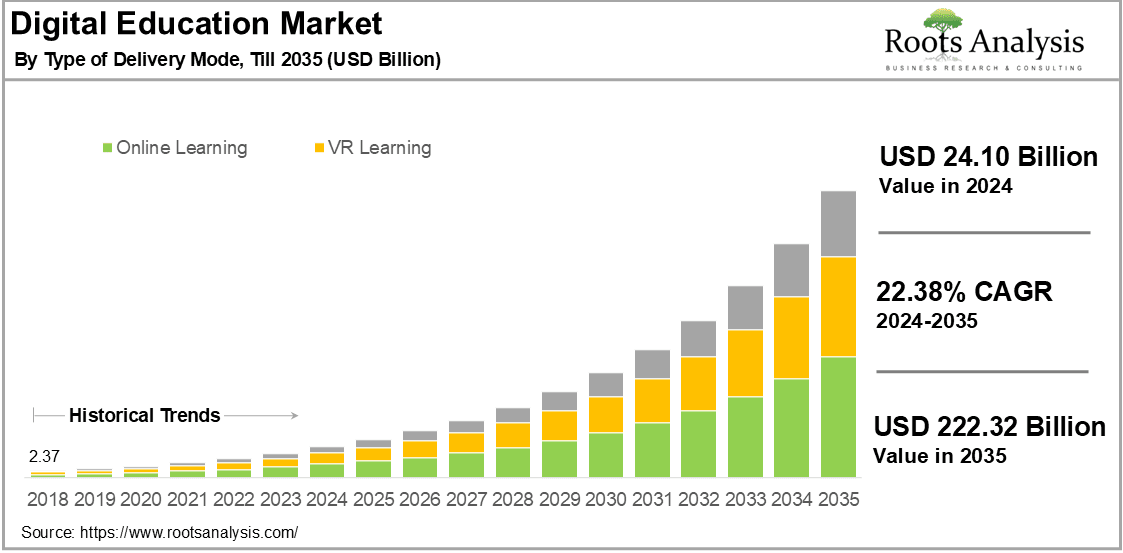
I came across Roots Analysis recently, and they mentioned that this market is growing at an incredible pace. According to their report, “The Digital Education market size is projected to grow from USD 24.10 billion in 2024 to USD 222.32 billion by 2035, representing a CAGR of 22.38%, during the forecast period 2024-2035. .” That kind of growth reflects how deeply digital learning is becoming part of mainstream education and workforce development worldwide.
Employers are also paying closer attention to online certifications and practical skills rather than focusing only on traditional degrees. In some industries, what a person can actually do matters more than where they studied. That shift is changing career paths for many people who previously felt excluded from higher education opportunities.
The Attention Problem Nobody Talks About Enough
Despite its advantages, digital education comes with challenges that feel very real in everyday life. Learning online demands self-discipline. That sounds obvious, but it becomes difficult when distractions are constantly nearby. Notifications, social media, streaming platforms, and household interruptions compete for attention every few minutes.
Traditional classrooms create structure automatically. Online learning often requires students to build that structure themselves. Some people thrive in that environment. Others struggle badly with motivation and consistency.
There is also something emotionally important about physical learning spaces that technology cannot fully replace. Classroom conversations, spontaneous discussions, friendships, and face-to-face mentorship still hold enormous value. Human connection remains a major part of education, even in highly digital environments. The future will probably not be fully online or fully offline. Most likely, it will blend elements of both.
Digital Education Is Changing the Meaning of Learning
Perhaps the biggest change digital education has created is philosophical rather than technological. For a long time, education was seen as something tied to a particular age or stage of life. You studied during childhood or early adulthood, earned qualifications, and then entered a career. Today, that idea feels outdated.
People now learn continuously. Careers shift faster. Industries evolve constantly. Skills that were valuable five years ago may already need updating. Digital education supports this new reality by making lifelong learning more practical and accessible. Someone can develop new skills at thirty, forty, or even seventy years old without needing to completely pause their life.
That flexibility is powerful because it changes education from a one-time phase into an ongoing process.
Conclusion
Digital education is not perfect, and it certainly does not solve every problem within modern learning systems. There are still challenges involving accessibility, engagement, quality, and digital fatigue. But despite those issues, something important has undeniably changed.
Learning is no longer confined to specific buildings, schedules, or stages of life. It has become more fluid, more immediate, and in many ways more human because people can shape it around their own realities.
That may be the most meaningful part of all. Digital education is not just transforming classrooms. It is transforming the relationship people have with knowledge itself.